
The 7 Frameworks to Understand Post-Labor Economics
I've distilled 3 years of research into 7 graphics

My book Labor/Zero: A Post-Labor Economics Treatise just launched on Kickstarter, so I could really use your support! The link is here:
https://www.kickstarter.com/projects/daveshap/labor-zero?ref=6ob1za
In the meantime, I wanted to distill this book down into seven intuitive frameworks so that you can understand Post-Labor Economics in its simplest form.
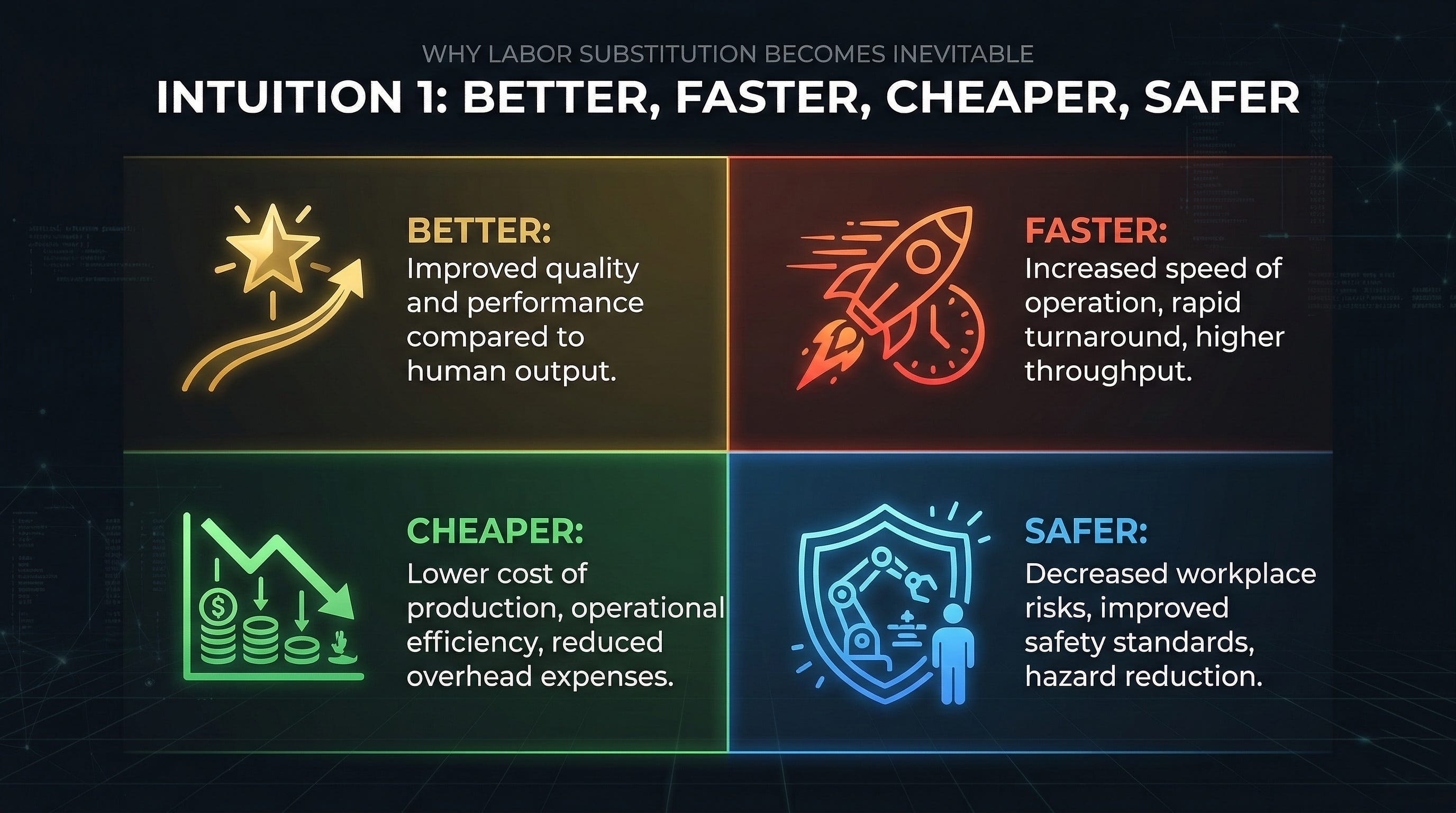
Intuition 1: Better, Faster, Cheaper, Safer
Labor substitution is when a machine replaces a human at something economically valuable. Modern grain harvesters replace hundreds of farmhands as they cut, thresh, and sort produce all in one machine. RPA (Robotic Process Automation) has been eliminating back office jobs for a few decades now, and LLM-based AI is accelerating that trend.
When we take the long view of history, there’s a simple litmus test that a new technology must pass, and then labor substitution becomes inevitable: better, faster, cheaper, safer. When a machine passes those four criteria, versus human baselines, it becomes economically irrational to hire humans, and thus substitution becomes inevitable.
Intuition 2: Strength, Dexterity, Cognition, Empathy
Many people believe “there will always be more work to do” which is true! The amount of work we need to do, as a species, is functionally infinite. There’s always more science, engineering, and law than can be done. Once we become a spacefaring civilization, colonies aren’t going to build themselves!
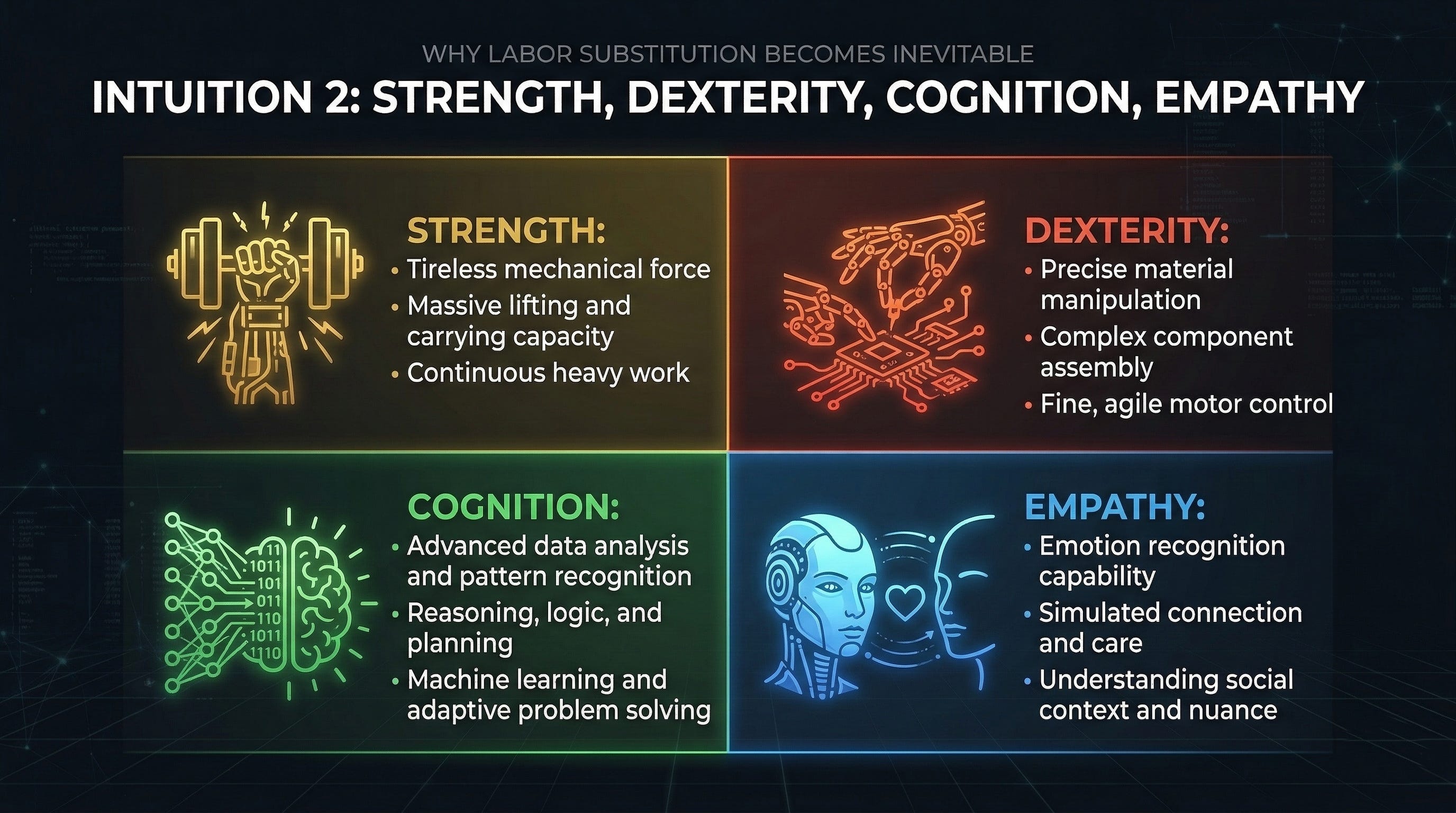
But there’s no law of physics that says humans must do those activities. When we look at the “labor supply” side of the equation, we see that humans fundamentally offer the economy four things: strength, dexterity, cognition, and empathy. Every economically valuable task that humans do is a combination of those abilities. Marketing and sales is a combination of cognition and empathy. Neurosurgery is dexterity and cognition. You get the idea.
But here’s the rub: machines are starting to supply all four of those “food groups” of labor. That means the supply side of the labor market is about to get very, very saturated. Now, that doesn’t mean that 100% of jobs go away forever, we’ll talk about that intuition at the end. But in the meantime, the important intuition is that we have only four economically valuable attributes that we can parlay into wages: strength, dexterity, cognition, and empathy.
Intuition 3: Wages, Transfers, and Capital
The formula is simple: if AI and robots take all the jobs, then wages dry up, aggregate consumer demand drops, companies have to lay off even more employees, and we end up in a vicious cycle. You can’t sell goods and services to a bankrupt population. That is the “deflationary death spiral” of the worst-case scenario.
Thus, the crux of the problem of Post-Labor Economics is this: “How do we shore up household income?” Household spending drives >70% of GDP. Without household spending, the economy stalls. That’s the keystone. That’s the linchpin.
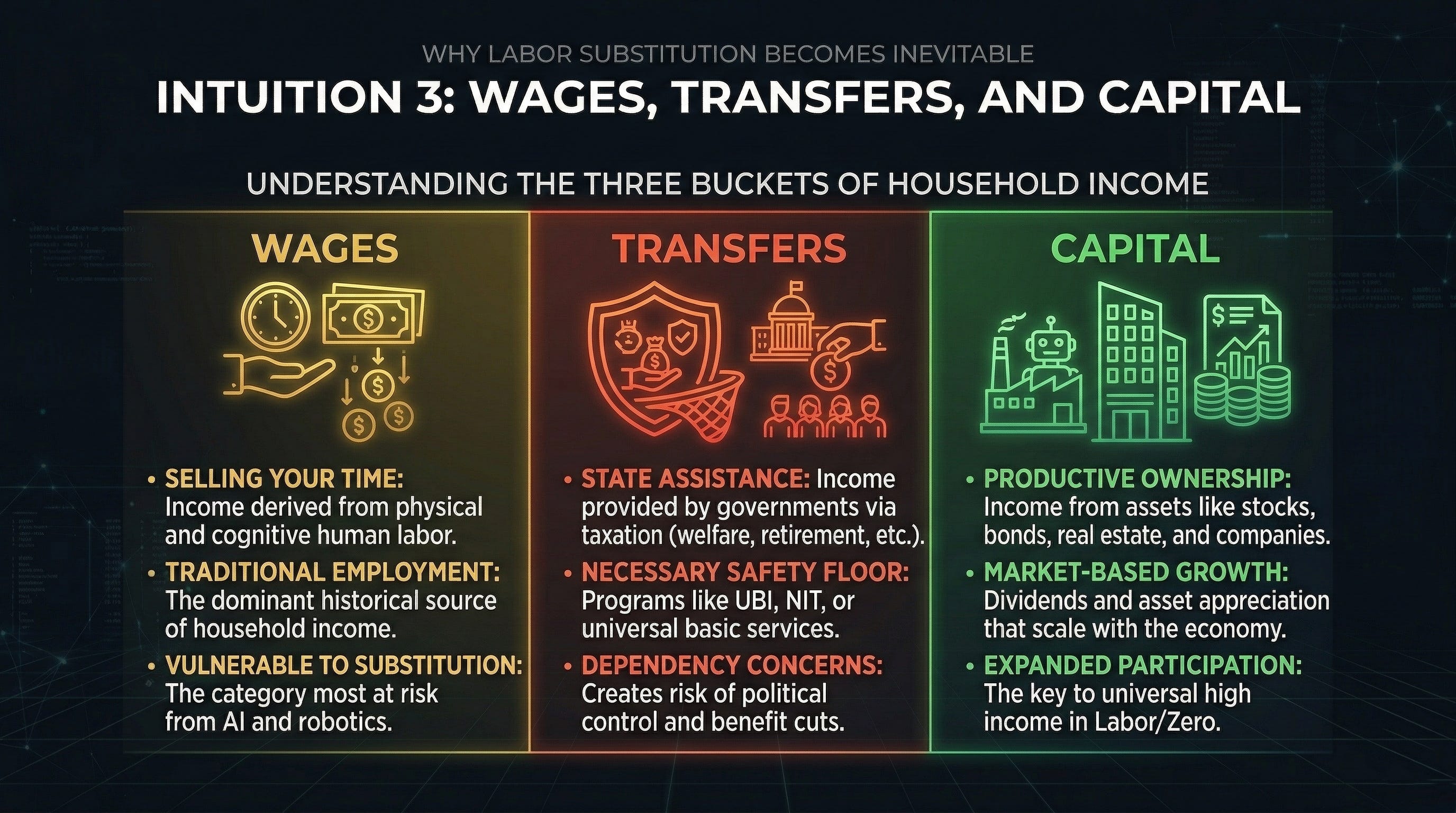
So let’s look at where households get their income to spend. This data has been tracked for decades by government agencies such as BEA (Bureau of Economic Analysis). They break household income down into three buckets:
WAGES - Income from selling your time (including self employment)
CAPITAL - Income from owning productive assets like stocks, bonds, and real estate
TRANSFERS - Government assistance in the form of welfare, retirement, education, and healthcare (would also include UBI)
Wages are going away, therefore capital and transfers must pick up the slack. But the problem is that most people focus just on transfers. They concoct increasingly elaborate ideas about UBI and UHI, while ignoring capital. But we’ll get to that in a moment.
Intuition 4: Double Bilateral Dependence
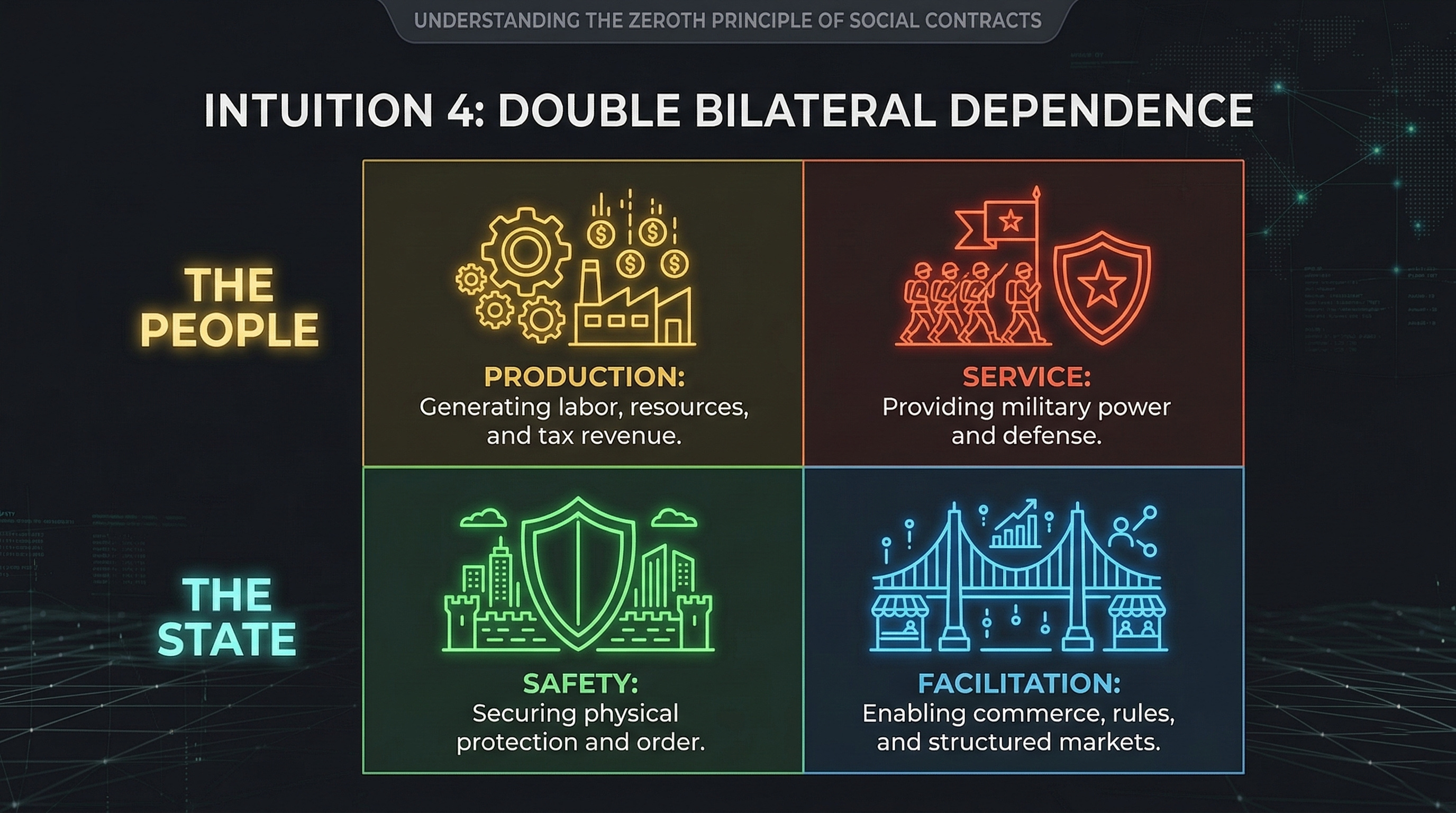
Before we solve the money problem, I have to introduce the darkest problem we’ll face. That is what I call double bilateral dependence. This is a fancy term that means “the State has always depended on the People for some things, and the People have always depended on the State.” And this creates negotiating power.
The State requires production (labor, taxes) and service (soldiers, army) from the people to function. The People require safety (physical protection) and facilitation (enablement of markets and commerce) from the State. This is the “zeroth principle” of all “social contracts” and explains how literally every government, from ancient monarchies and empires, to modern democracies, have functioned. Not metaphysics, and not enlightenment ideals. Just a cold hard exchange of dependence.
However, AI and robotics threaten to shatter this double bilateral dependence. When robots and drones can conduct war, and the same can conduct labor, suddenly, the State no longer needs the People. When humans become optional to the state, so does listening to them.
If this gives you the willies, that’s because you’re paying attention.
Intuition 5: Broaden Capital Participation
First, let’s solve the household income problem. Programs like UBI (Universal Basic Income) and NIT (Negative Income Tax) and guarantied income (GI) are all necessary-but-not-sufficient. Here’s why: 100% of those rely on tax-and-spend schemes AND they make you entirely dependent upon the government. No one wants that. No one wants a population that is forever a financial outpatient of the government. If your benefits get cut off for any reason, you are completely screwed. That means politicians can hold your livelihood hostage.
Frankly: fuck that noise. Ain’t nobody want that.
So what do we do? We must broaden ownership of the economy. Market-based solutions, property based solutions, all geared for creating more capital based income. Remember the three buckets model of household income? UBI is a transfer, which is great. It will be necessary as a floor.
But with wages gone, that means that simple process of elimination says: we need more capital. Now you might be wondering “how do you get capital if you don’t have any to start with?” The answer is simple: we still start with the state, but we don’t end there.
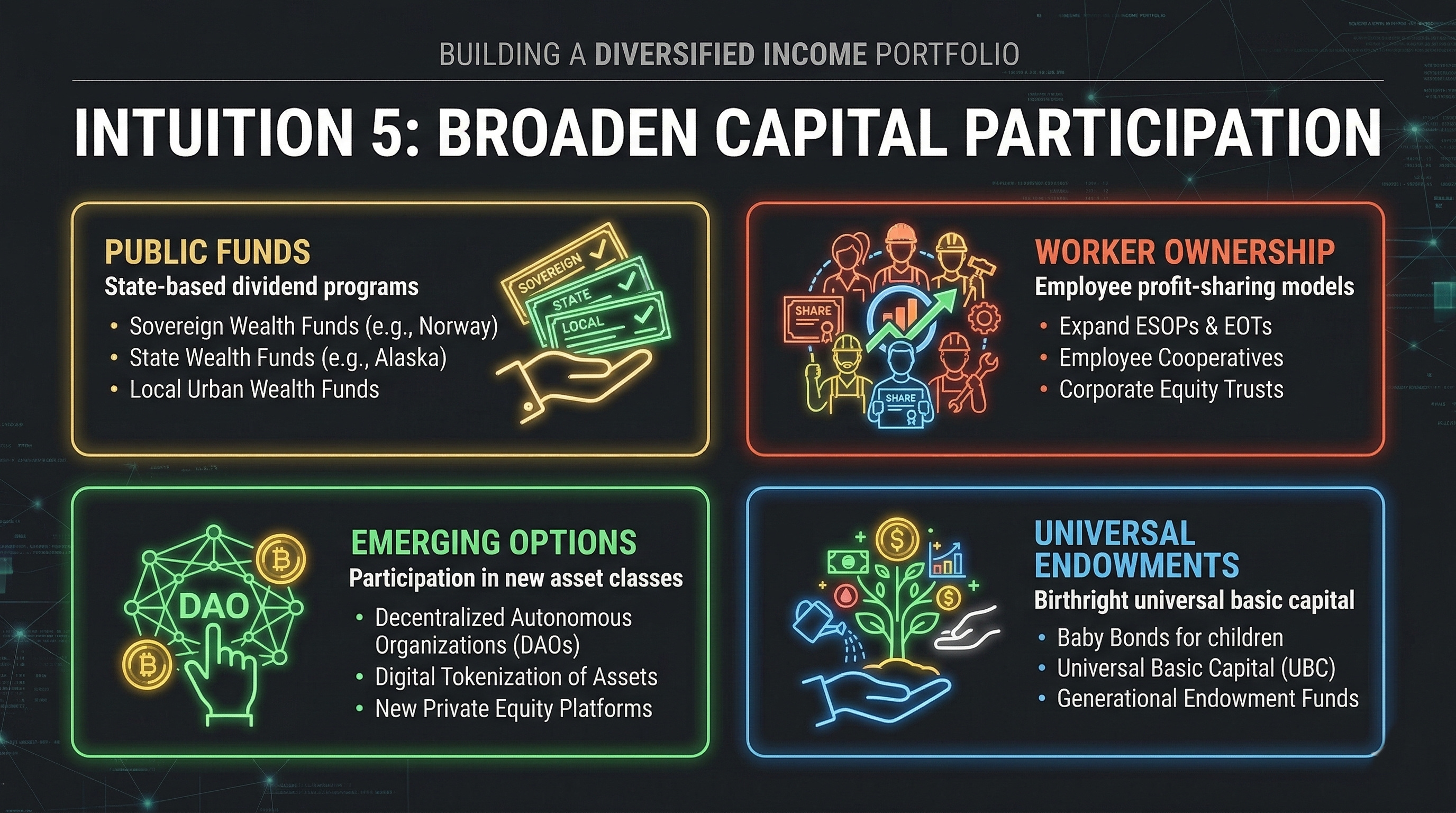
Start with Sovereign Wealth Funds like Norway’s pension fund.
Add in State Wealth Funds like Alaska’s Permanent Fund and New Mexico’s Land Grant Permanent Fund.
Add in local urban wealth funds.
These funds all pay out dividends or provision services. Once they are all set up, you’ll be getting no less than three monthly or quarterly checks from different levels of government, just by being a citizen. But that’s just the public side of the equation. Now let’s look at the private side.
Expand ESOPs, EOTs, cooperatives, and trusts - private equity for the companies you already work for and shop at.
Add DAOs (Decentralized Autonomous Organizations) to create entirely new private equity options.
Add Baby Bonds and other forms of Universal Basic Capital (birthright endowments).
When you combine all the TRANSFER based programs with all these CAPITAL based programs, every household ends up with a portfolio of income, some managed by the state, some managed privately. The transfers serve as the universal floor, while the capital programs expand and grow with the economy.
This is how you create Elon Musk’s idea of “universal high income.”
Intuition 6: Replace Labor’s Leverage
Now we address the darker problem of leverage. When double bilateral dependence breaks, we basically just become cattle to the state. A drag on the system unless we have a we to either contribute, or force those in power to the bargaining table. First, I need to clarify that it is nobody’s best interest for the economy to come grinding to a halt. Simple rational self-interest will ensure that billionaires and politicians do something to shore up household income.
But, I don’t know about you, I don’t want to rely solely on the good will and common sense of billionaires and politicians. That’s where the concept of credible threats come in. Throughout ALL of history (and I mean literally all of human history) the ONLY thing that can force adversarial parties to the bargaining table is a “credible threat.” In some cases, such as for the signing of the Magna Carta, it was literally that a bunch of lords stormed London and said to the king “sign this if you want to live.” Naked force is the ultimate backstop of credible threats.
Beyond that, labor unions figured out that you don’t need to use violence to force people the bargaining table. You just... stop working. Shut down the ports. Shut down the mines. Every day of production lost is permanently gone. However, with AI and robotics, we cannot unionize them. They are property, they are tools, and they do whatever their owners say.
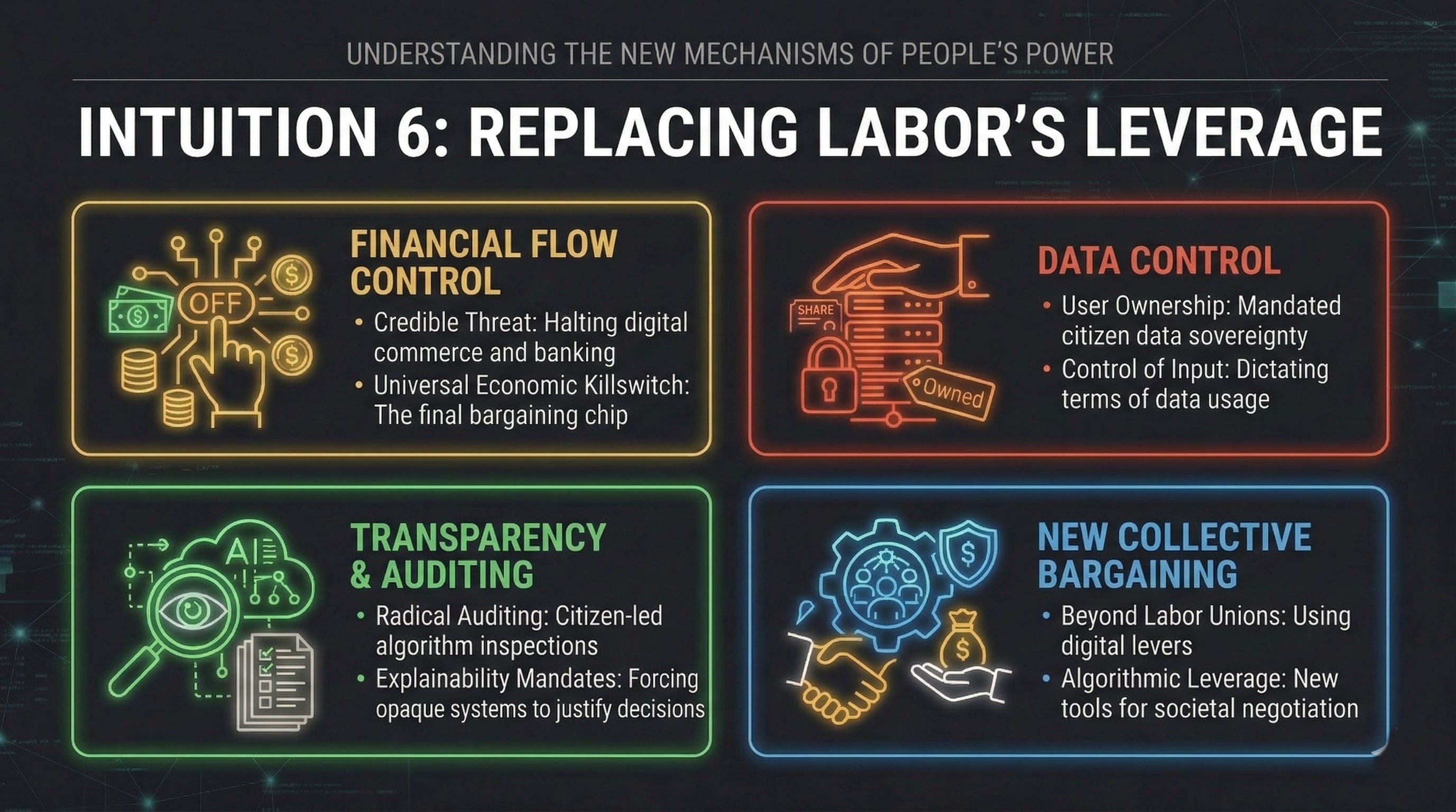
Thus we need an entirely NEW stack of levers. This is the most complex part of the book, so I’ll simplify it here and just call it all “algorithmic rights.” This is the ability to shut down financial flows, enforce radical transparency, and control data. By building a new infrastructure around the very technology that will eradicate the need for human labor, we can ensure that not only does property stay in the hands of ordinary citizens, but so does the economic killswitch that will force the elites to the bargaining table.
Intuition 7: The Meaning Economy
Finally, let’s address the demand side of the labor market. We already see that the supply side is going to be saturated by machines, meaning that for every valuable task, a machine will be able to do it better, faster, cheaper, and safer than a human. It therefore becomes economically irrational to hire humans in every case.
However, humans are not always rational.
Let me give you an example: let’s say you want to listen to Taylor Swift music. You can just subscribe to Spotify for the price of a couple lattes per month and listen to unlimited Taylor Swift. Yet people still spend hundreds of dollars on concert tickets, hotels, and flights to go see her live. Why? The sound is better at home, in your headphones. The reason is because humans are totally irrational when it comes to meaning. Our bodies evolved to attune to other humans and have embodied, real experiences.
Let’s create a framework to understand this. The economy is presently demarcated into three distinct sectors:
PRIMARY - this is the “extraction economy” which includes mining, farming, fishing, timber, and so on. Nature provides the baseline.
SECONDARY - this is the “manufacturing economy” where we take raw materials and transform them into steel, concrete, parts, engine blocks, and so on.
TERTIARY - this is the “services economy” where goods give way to services, like lawyers, doctors, engineers, and so on. This is the vast majority of the economy today, including all knowledge work.
History shows that that primary sector now accounts for less than 2% of the entire economy of advanced nations. The secondary sector is following suit. The tertiary sector peaked in the last decade, meaning it will begin its gradual decline around now.
But there’s a fourth sector.
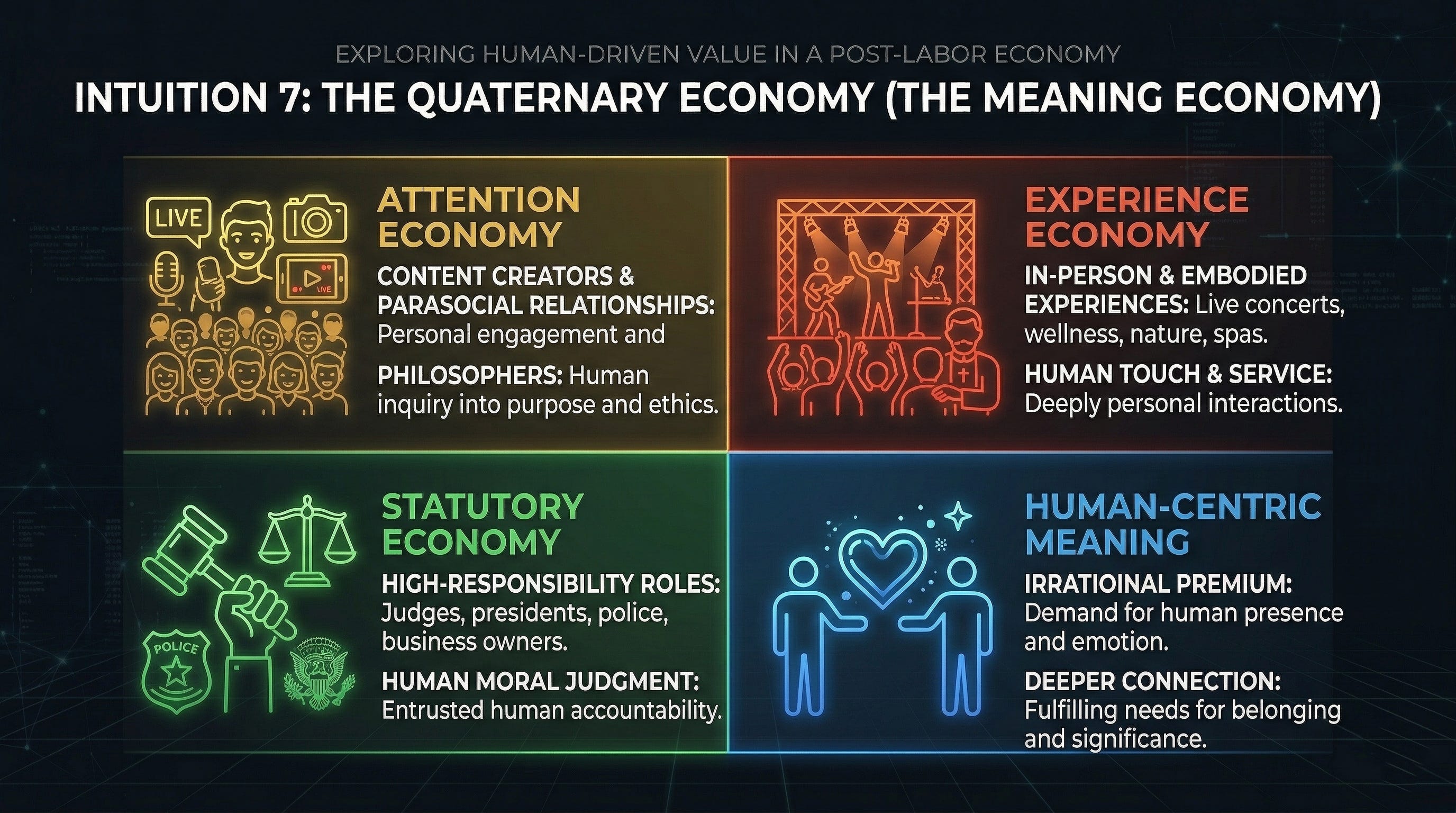
QUATERNARY - this is the “meaning economy” which is broken down into all the economically irrational things that humans will pay a premium for the privilege of other humans to do.
Let me give you some examples:
The Attention Economy - Content creators, parasocial relationships, and one-to-many connections mediated by networks. Philosophers also operate here.
The Experience Economy - Embodied, in-person, and local experiences like concerts, spas, massages, and white water rafting tours. This is the domain of priests as well.
The Statutory Economy - High responsibility and accountability jobs that we want humans to do for moral reasons (police, judges, presidents, business owners).
There will always be plenty of jobs to do, unfortunately there won’t be enough for EVERYONE to have a job. The quaternary economy simply cannot absorb that many people, there’s not enough human attention to go around. But, everything in the quaternary sector breaks down into subcategories circling that idea that humans irrationally will pay a premium just for the engagement of other humans. Hence, the meaning economy.
Conclusion
You now understand the full scope of Post-Labor Economics. At least at a high level. If you want to know more, go support my Kickstarter campaign. The finished book is 180,000 words with hundreds of citations, and I will do the narration personally.
Beyond that, it’s not just enough that a ew people reading this article understand PLE. The reason that this book needs to exist is so that we can get it into the right hands. Politicians, billionaires, think tanks, professors, and decision makers and influencers of all stripes. The best way to ensure that PLE gets implemented is with a rock solid book. By supporting me on this book launch, you’re voting with your wallet to say “yes, I want PLE to exist.”
Here’s the link:
https://www.kickstarter.com/projects/daveshap/labor-zero?ref=6ob1za
Every little bit helps, now let’s get it done.
Congrats on finishing the book, will buy. Conversations around these subjects are sorely needed.
Congrats on the book ! Your early videos inspired our take on liquid labor clusters for the hospitality industry!!