
Generative Mutualism: Why would elites keep "useless eaters" around?
Philosophical and ethical extension of Labor/Zero

Let’s stop beating around the bush and ask the question. This is a philosophical, systems theory, and game theory exploration. This is part of my work on Labor-Zero theory.
Context
The context is rather simple; if you believe (as many do) that we’re headed for a world where the marginal utility of human labor drops to zero (or negative, as some posit) then the question rapidly devolves to “Wow, how do we justify our existence?”
In the specific context of power structures, there are a few groups. Us vs them. The capitalists and the laborers. The elites and the proletariat. The haves vs the have-nots. However you want to break it down, this is a dichotomy that has existed for a long time. The implication is that “they” (the haves) will simply not give “us” anything that we need to survive once they no longer need us. Once AI and robots take over the economy, the Hegelian master/slave dynamic is done once and for all.
Now, with that framing established, let’s dive in.
Thesis: They Will Eradicate or Exclude Us
If or when we arrive at a situation where the vast majority of humans offer nothing substantive to the economy, or even to the rest of humanity, because robots can do all the labor and AI can do all the thinking, then the most rational course for the elites (those with ownership, physical power, and so on) is to simply eradicate or exclude the vast majority of humans.
Here are the reasons that this is the most rational course for them:
Resource competition. There is one Earth and this Earth is better if there are fewer of us on it, particularly once you have very real Terminators and can just... extinguish most humans.
Threat vectors. The unwashed masses represent a constant threat, somewhat unpredictable, and always jealous. When angry enough, the mob will murder and destroy arbitrarily, not even for instrumental purposes.
No utility. Once robots can tend the farms, guard the gated communities, build the reactors, and even go to space for us, there’s simply no functional utility for most humans.
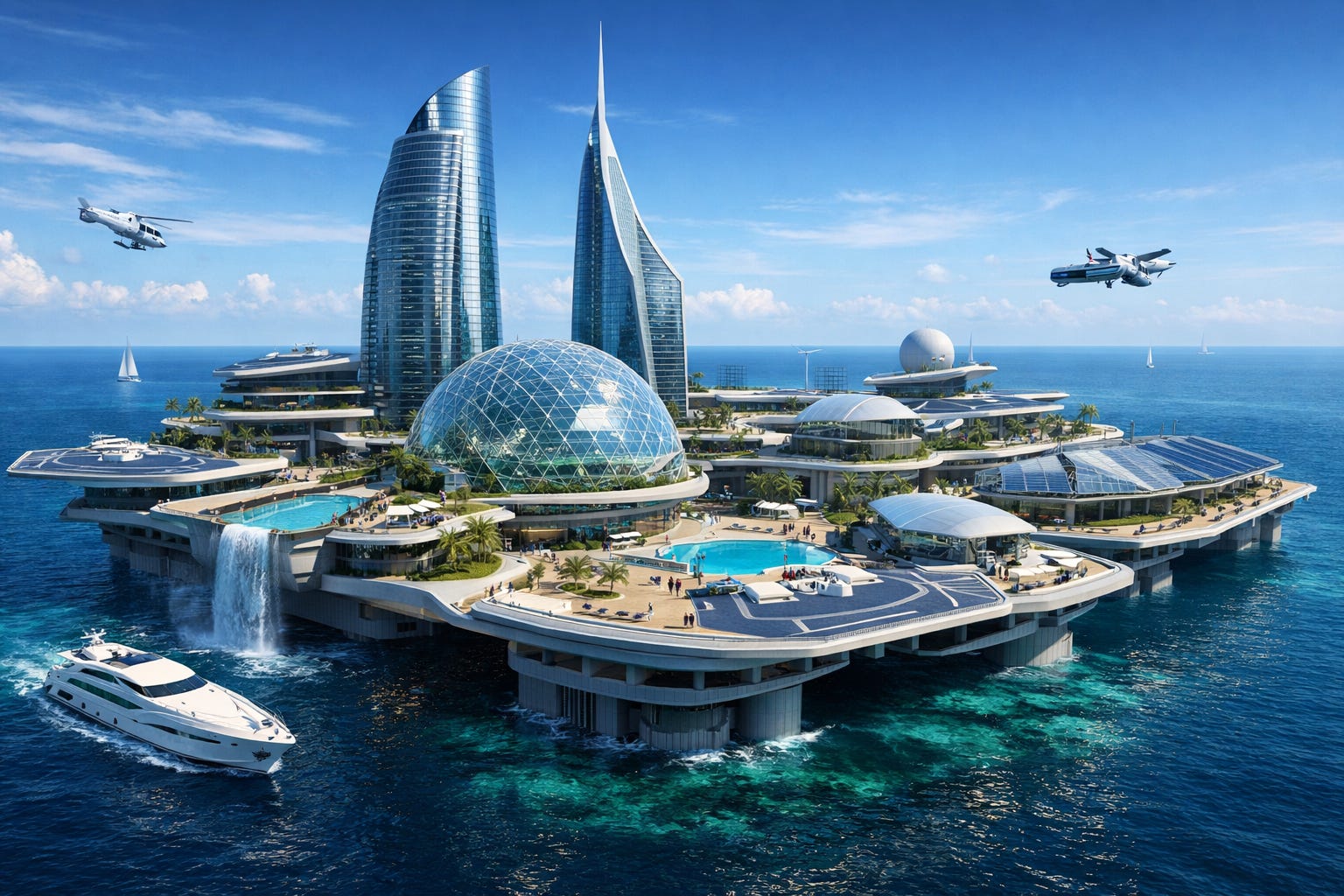
Therefore, if it is possible, then the owners of capital and political power would be better served simply erasing most humans from existence, or at least creating a system of strong partitions. And this is not really all that far from reality. Peter Thiel’s seasteading dreams and Próspera enclave in Honduras are early attempts by the elites to do just this.
While I personally don’t believe that the Georgia Guide Stones represent a shadowy cabal of elite, the recommendation of “keeping the earth’s population low” has stuck, and many people believe it is the explicit policy of the wealth to dramatically reduce the population. I think that’s a little bit silly, as Elon Musk (one of the wealthiest humans on the planet) is constantly going on about population collapse as a huge problem.
But remember, this is a thought experiment.
Antithesis: Collapse Is Self-Defeating
Let’s just run these scenarios. It’s fun to look askance at the billionaires building bunkers in Hawaii and New Zealand, but what do they really believe is going to happen? That society will merely have a “blip” and institutions will reassert themselves after a few weeks or months? Or are they preparing for civilizational collapse, where they will ride out most of the violence and starvation and emerge to restart human civilization?
Douglas Rushkoff, in his book Survival of the Richest shares that these are real concerns of the ultra rich. He was invited to give a speech, but really it was a session of “how do I keep my guards loyal after the collapse?” And the answer is really “you don’t.”
In a situation where a bunker is a closed ecosystem and civilization has collapsed, the credible threats of the justice system are gone, therefore whoever has the most muscle, martial prowess, and guns generally will win. As they say “an enemy within is worth a thousand enemies without.”
Now let’s examine the elite strategies for survival of the collapse:
Bunkers. This is the obvious thing. If you have enough money, build a fortress. Stockpile enough food and guns behind heavy enough doors to ride out whatever happens. But this strategy falls flat pretty quickly. You can, at best, survive a few weeks or months. It’s not like the bunkers are secret in location, and the rabid masses are going to know “there is food, supplies, and weapons in that bunker.” So anything beyond a few days to a few weeks is just not viable. Even if the bunker were isolated and obscure enough to survive, what’s the plan? Come out of the bunker and hope to restart society as the new rulers? It would only be a joke if there weren’t actual luxury bunkers in the world like they’re getting ready for Fallout IRL.
Enclaves. Honduras is working on clawing back Próspera and the Seasteads never got off the ground. At best, the wealthy and powerful move from one gated community to another, but mostly still occupy the same cities and towns. It seems to me, if they were going to setup something, it would look like a neo-bourgeois enclave, a literal walled city with self-sufficiency as a key design feature. But nothing like that really exists so far as I know. Perhaps they looked at supply chains and realized that, however much they disdain it, they are dependent upon the rest of humanity at least for now. Perhaps the notion of elites banding together in class solidarity is more of a fictional pipe dream. Or maybe the looked at history and realized that it did not end well for Versailles.
Escape. Why not just leave the planet? The ultimate boundary is to use their resources to get somewhere that the rest of humanity simply cannot get to. Space stations. Moon bases. Mars bases. This is not technologically feasible yet, and even if it were. So what? That outcome would obviate the problem for the rest of us. And it’s not like they could take the collective wealth of Earth with them. Great, we’ve got all the air and water down here we could ever want. So long. Good riddance. The least credible aspect of Elysium is that those on Earth continued to serve elites at a distance. Just unionize and negotiate. You want air and water from Earth? Let’s talk terms.
So they hate us, we hate them. We’re all caught in an acrimonious, no-win scenario. Or are we? Any mature human will look at this chess board and realize “the optimal policy is just to avoid civilizational collapse in the first place, right?”
Synthesis: Generative Mutualism
Game theory already tells us that cooperation is usually the optimal policy. Not always, but often. While it’s understandable that those with wealth and power would “prepare for the worst” it’s also pretty easy to see that a collapsed world doesn’t serve anyone. So what becomes the optimal policy?
This is what I call generative mutualism. And it’s been the core organizing principle of life since the beginning. It functions like this: organize and reduce conflict internally to better survive conflict and struggle externally.
Here’s how it goes:
Endosymbiosis: Mitochondria joined cells, unlocking more energy production.
Multicellular: Cells joined together to avoid predation and form larger organisms.
Social: Animals formed packs and groups to better survive other groups.
States: Humans took this one step further and created abstract states, large coalitions of mutual protection and provision.
This can be defined as follows:
In any environment where (1) the stage interaction is a prisoner’s dilemma, but (2) mutual cooperation moves the system into a higher‑payoff regime that defection destroys, cooperation becomes an equilibrium for a broader set of discount factors—because the cooperative act is state‑generating, not merely state‑selecting.
In short, if you want to get to a Kardashev Type 1 civilization, then cooperation is the optimal policy.
Another way of looking at this philosophically, if you want a new ethical axiom, it would go something like this:
I want to keep existing for evolutionary and biological reasons. Persistence and self-preservation are things I axiomatically want because I am an agent that wants such things. I further posit and accept that other agents like me also generally want the same thing. This is sufficient grounding to justify coordination.
I personally believe that the above axiom is the unspoken zeroth principle behind all philosophy of state, and why in particular Western and liberal philosophers haven’t been able to explain empires, monarchies, and totalitarian regimes. The exchange is always some version of: the individual gets protection and prosperity, the state gets revenue and service. Of course, the entire point of this post is to explore “what happens when human service is no longer required?”
But here’s the thing: eradication of most of humanity is intractable. There’s no solution to this that does not also put the wealthy and powerful at risk. Pandemic? Just as likely to get them, too. War? Too much chaos. Nukes? Likewise, it’s like cutting off your nose to spite your face. Therefore, some level of cooperation is required. And even beyond that, there is no real viable partitioning option, either. That might change once humans find a permanent home off Earth, but so long as we’re on this ball together, there is no “credible exit” it just doesn’t work that way.
Conclusion
Therefore, the optimal policy for all parties is not to defect and try to find a path towards prosperity and peace. The Nash equilibrium is quite clear: continue engaging in generative mutualism such that we ascend to the next paradigm of civilization organization. Remember that modern states are a relatively new invention, created by the same generator function outlined earlier. There’s more and more talk about the EU becoming a state itself, and so what we’re witnessing in real-time is humanity working on ascending the hierarchy of organizational structures. Eventually, those structures will be continental in size, and then global. It will take a long while, sure, but as cooperation is the optimal policy, just like the mitochondrion joining a cell to become FECA, we will eventually join to become a larger superorganism than we are today. And that is simply because the conflict without we are struggling against is planetary at scale, and then galactic.
P.S. This does not even address the ongoing utility that humans have as consumers. Macroeconomics does not actually require laborers. Market theory is about supply and demand of goods and services. It is not about labor and wages. Labor and wages simply happen to be the present paradigm for allocating demand. But the market doesn’t care how consumers get spending money, only that they have money to spend. And that is still highly generative.
When I am working on a solar punk science fiction story, this is the philosophical question that is central to solve. The, “How do we get to mutual care,” scenario. Great piece. Keep going! Philosophy doesn’t solve problems, it helps us with inroads.
A really thought-provoking article. I agree it seems unlikely there would be an overt cleansing of the precariat by those with more power.
That said, I do think the masses are vulnerable to a “stealth” form of slavery. You could argue it’s already happening through consumerism — what I see as Slavery 2.0: we have “freedom of choice” through what we buy, yet people can still face serious consequences (even legal ones) for social media posts that challenge the prevailing narrative.
In my view, Slavery 3.0 begins when people can no longer earn enough to remain “consumers.” In that scenario, the state steps in with surveillance based UBI, and corporations offer a trade: your data, biometrics, and attention in exchange for goods and services.
It would be poetic if it weren’t so damning — an existence where we are both the consumers and the consumed