
Adversity reveals genius, good fortune conceals it
Life is always going to be hard in some ways, but maybe the techno-abundance has an Achilles heel

As I sit here writing this in my automatically heated home, reflecting on the ease my income as an AI expert affords me, I wonder “what will happen if we make life too easy with AI and automation?”
Will humanity get soft? Will this be the final emasculation of Western society?
But then I immediately think how silly this is. How privileged. How absurdly self-absorbed one would have to be to prognosticate about the travails of a good life would be.
After all, is it not true that plenty of people have had a gentle life, yet still achieved great things? From aristocratic scientists and explorers of England, from Newton to Darwin, was it not their wealth and privilege that afforded them the opportunity to advance human understanding as they did?
At the same time, is it not also true that an easy life does provoke softness? Too little stress in one’s life results in cognitive decline, muscular atrophy, and depression. We evolved in such an environment that our minds and bodies were taxed. That is the birthright and genetic legacy of our ancestors—those who were able to survive and thrive in an unkind world passed on their genes.
In that respect, are we not engineered to embrace the struggle somewhat?
But this begs the question: so what?
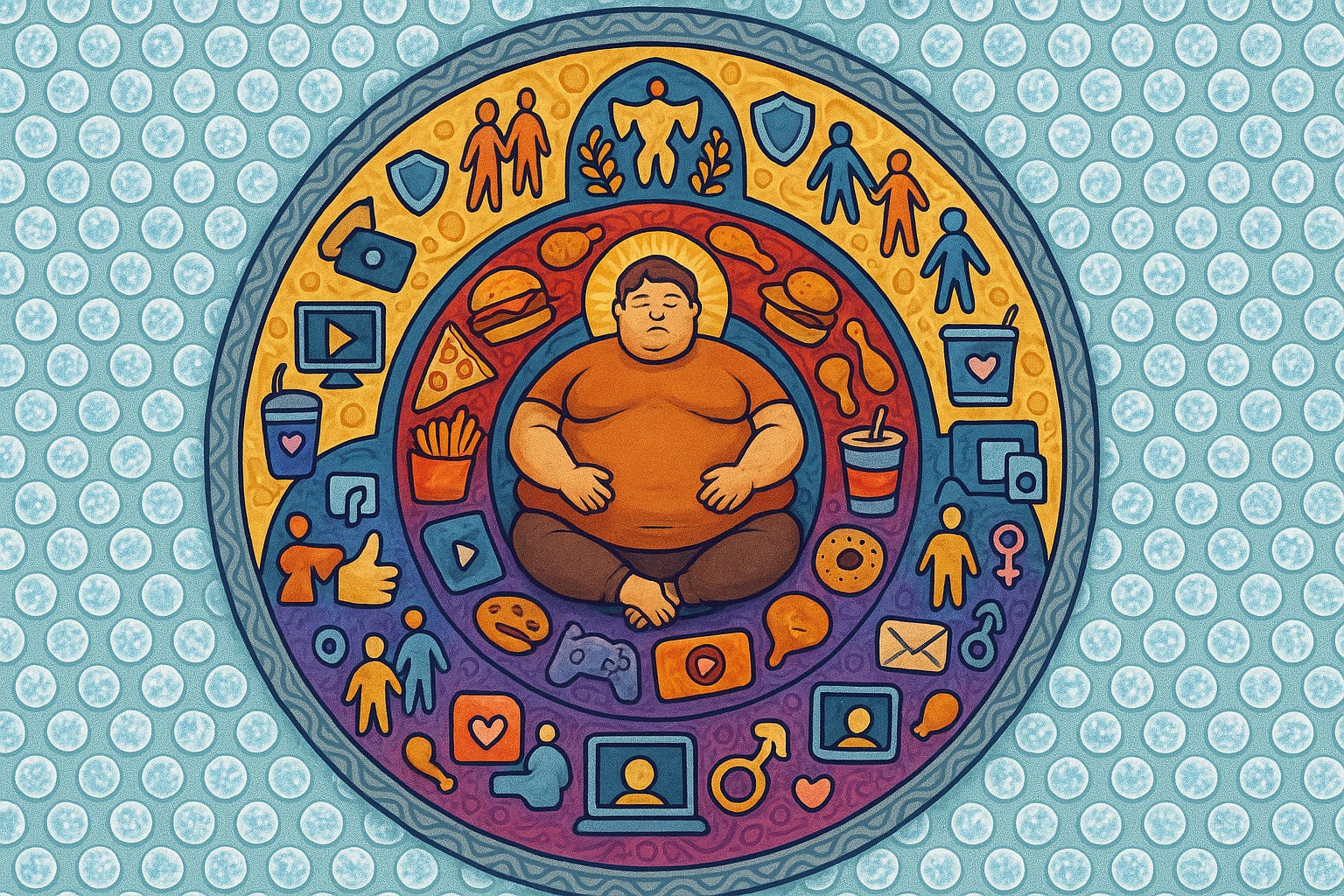
So must we destroy our technology, to make life harder, such that we live in accordance with our evolved tendencies? Must we abort our progress on artificial intelligence, robotics, quantum computing, and genetic engineering lest we accidentally make life too easy for ourselves and our children? Mayhaps we should all simply return to the forests to scrape a living by foraging and competing with the lions?
Of course, when cast in this light, we see how ridiculous such thoughts are, when taken to their terminus.
Likewise, it would be too presumptuous, too premature to make a declaration that “life will always be hard enough” and that new challenges will arise. Even when some of those challenges are self inflicted. Look at obesity—humanity has finally conquered hunger, and yet the cost has been steep. Murphy’s Law applies, as does the Law of Unintended Consequences. Dalio points out that first and second order consequences are often inverted in polarity. If the first order consequence of a thing is good, the second is bad, and vice versa. In the case of caloric hyper-abundance the first order consequence (cessation of hunger) was good, while the second order consequence (rise of diabetes and CVD) was bad.
On the topic of food, our forebears might say “wow! what a peculiar problem to complain about!”
The dose makes the poison, as they say.
My point is that whatever largesse we render from our technology, ostensibly good on the surface, will have knock-on effects that we will also need to wrangle with. The internet serves as another stark example. The first order consequence; instant global communication. The second order consequence; social media addiction, porn addiction, post-truth reality.
Returning to Newton: for every action there is an equal and opposite reaction.
On the surface, artificial intelligence, robotics, and advanced automation promise to liberate us from the drudgery of wage slavery; to create a state of cognitive hyper-abundance. Many have asked me what this will do to children and learning. Will it cause our minds to atrophy? For some, I think yes. Social and technological safety nets save people from the consequences of their actions, and buffer them against their own stupidity. Some social commentators posit that your average human today is simply not clever enough to survive previous eras.
Even yours truly, all my knowledge and skills with technology would mean very little should I suddenly find myself in prehistoric France. I could tell them “the mitochondria is the powerhouse of the cell” to which they would ask “do you know how to light a fire or make a bow?”
The aspersions I am casting at society today are tantamount to the pot calling the kettle black. We are all equally soft by some arbitrary set of standards. Should we find ourselves in Roman Legions, we are clearly frail and foolish. But should the roles be reversed, do you think a typical hastati would make it on Wall Street? Surely not. We have traded lorica segmentata for wool suits.
From this we can glean a specific principle of the Struggle: it always evolves. As we do battle with our own success—against obesity and depression—we must realize that in conquering disease and hunger, we simply invited the shadows within to supper.
This is not to say that it is an immutable rule of the cosmos, that some level of reciprocity will always be true. This is not the monkey’s paw that grants wishes with a twist of irony. We will one day soon conquer all aging, all disease, and even intelligence at its core. And from these technological primitives, we will create newer, more abstract layers of problems for ourselves. Just as taming fire ultimately led to climate change, so too will we reach new ontological strata as our new exocortex comes online.
We seem to be metabolizing every sin as we progress. Gluttony became a problem in the 20th century. The spirit of Wrath is alive and well now. Perhaps Sloth is our next arch nemesis. This is the structure of the thing we are building, the net effect of the system doing what we designed it to do. By solving agriculture, we became fat. By solving communication, our values clashed. Next, by solving work, perhaps we all become lazy.
Indeed, what a problem to have.
David, will AI care? Over the next hundred years, the landscape, the space we inhabit will change. Even the melding (or not) of AI and humans, and the solar system we inhabit will expand....me thinks.